Showing posts with label George Romero. Show all posts

Thursday, November 3, 2016

"Trick or Treat"


Original Airdate: October 29, 1983

Directed by Bob Balaban.

Written by George A. Romero.

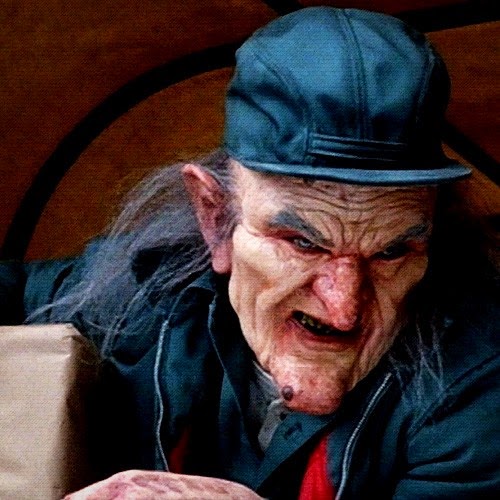
Starring Barnard Hughes (Gideon Hackles), Joe Ponazecki (Atticus Kimble), Knowl Johnson (Billy Kimble), Eddie Jones (Victor Muldoon), Patrick Wilcox (Timothy Muldoon), Frances Chaney (Witch), Ed French (Devil).

SYNOPSIS: Gideon Hackles is the resident miser of the farming community he lives in, holding the villagers in a steel grip of debt. As part of an annual Halloween tradition, Hackles gives the local children the opportunity to track down the bundle of IOUs he has hidden in his spookhouse-rigged estate. If any one of the children can claim the bundle, then all their families’ debts shall be relieved. But Gideon guarantees that his prop ghosts and ghouls scare the kiddies away before they can sniff the prize out… that is until he receives a surprise visit from a very real witch intent on meting out some justice.


CRITIQUE: As far as first impressions are concerned, TALES FROM THE DARKSIDE could hardly have made a better one than this episode that premiered a few days before Halloween 1983. “Trick or Treat” is a simple campfire tale, but it is executed with such finesse and a palpable sense of fun that it’s impossible not to enjoy it.

Gideon Hackles is the archetype of the miserable old skinflint incarnate, all nastiness and spite with nary a shred of compassion to be found in him. This is the kind of arch villain who would earn the hearty hisses of an audience attending a classic melodrama. Watching him laugh hysterically at terrified children certainly makes him an easy target for disdain! The part is played with a real relish by Barnard Hughes (in a far cry from his turn as the kooky but lovable grandfather from THE LOST BOYS [1987]) that allows Hackles to become the villain that we love to hate, the kind of character whose punishment acts as a cathartic release for the viewer.


In many ways “Trick or Treat” acts as a Halloween-appropriated version of A Christmas Carol. Both stories deal with a heartless man who receives a supernatural intervention in the midst of holiday festivities. The difference here is that the express purpose of the witch’s arrival is not to redeem Hackles, as was the mission of the three Ghosts of Christmas, but to punish him. While Scrooge’s change of ways works well in promoting the hope and love that are the emotional trademarks of the Christmas season, Hackles’ judgment represents the darker aspects of All Hallow’s Eve perfectly: damning and terrifying. It seems ironic to note as well that Scrooge, who detested Christmas with a passion, got off a hell of lot easier than Hackles, who adores the mischief-making of the Halloween season. And whereas Dickens' story begins with a stave noting the demise of one character, Romero caps his with a baleful graveside inscription:

HERE LIES GIDEN HACKLES
A BUSINESSMAN. HE TOOK IT WITH HIM WHEN HE LEFT.

Though the story itself is unassuming in its emulation of the classic Comeuppance Tale, it still has small touches of artistic flair. When we first see Hackles, for instance, he is balancing his books with two bankers, a visor casting an emerald shade over his eyes. Right from the start Hackles’ obsession with money is made clear: he sees everything through a greedy, green veneer. The sight of him grinning impishly as he grasps a devilish pitchfork  almost overdoes it, but it’s too sugary-sweet to resist. Hackles may be an archetype, but he is a fully-realized archetype, with Romero providing him with some choice dialogue that complements his outward appearance and shows us the depth of his insatiable hunger. This is perfectly captured when Hackles sees a father hugging his traumatized son and, sneering, he spits “Backwards. People in this valley have it all backwards.”


Hackles not only finds compassion distasteful, but he views the families of the village as a lower breed to himself. He claims that they are slaves to their own circumstances, such as the failure of their crops during a given season, and that they create their own misfortunes. (Man, some things never go out of fashion!) The irony here is that Hackles doesn’t realize that he himself is a slave, except in his case he harvests currency, jewelry, and property collaterals. When the witch lays siege on his house, blowing his personal treasures all about, his instinctive reaction is not to run away in terror but to pathetically clutch at his money. He doesn’t even realize that he has literally stumbled through the very gates of Hell as he madly grasps at the billowing bills.

Even after he gazes into the hissing face of the Devil himself (who, in true E. C. Comics fashion, coos “You’re getting warmer…” just as Hackles had done to the visiting children searching for their prize), Hackles crawls after the money further into the Pit. So the master of fear and intimidation now finds himself on his knees before the Lord of Fear, a towering figure that smirks at him as the old man boorishly collects his harvest. When Hackles’ riches fall into the hands of young Billy at the end of the episode, we can almost hear him voice Tiny Tim’s famous line, except given the context of this story it would probably be more to the tune of “Satan bless us, everyone!”


Hackles’ scavenger hunt resurrects the thrill of the carnival haunted house, with the poor children groping in darkness as all manner of ghouls and ghosts leap out at them from the shadows. Hackles jeers at them from his hidden alcove, cackling through an amplifier like another famous humbug, the Great Wizard of Oz.

Though these sights are meant to kindle a sense of fear, they possess a charming, nostalgic quality to them that is in fitting with Halloween. The witch emits a laugh that could give Margaret Hamilton a run for her money, and a rather silly wooing sound effect is used to accentuate her ascent on her broom. The vision of Hell is equally effective and attractive in its own way, as the whole business is accomplished with the use of a red lamp, a fog machine, and walls covered in what appears to be bubble-wrap. This particular aspect of the episode demonstrates the series’ ingenuity and shows what could be accomplished with a solid sense of know-how.

DARKSIDE's pilot is all treat and no trick, and one that fans should indulge in every All Hallow’s season.


"It's Halloween, gentlemen! Halloween! Have you forgotten? My favorite season."

***

RATING: 4 Lizzies


COMING UP: Vic Tayback reconsiders the positives of vasectomy in “The New Man.”

Thursday, October 13, 2016

Send in the Creeps


Ah, but where would we be without CREEPSHOW?

Filmed in 1981, the horror anthology-cum-comic book tribute proved enough of a financial and critical success to warrant a sequel, but more importantly to our interests here, the original CREEPSHOW served as the seed for the program that was to become TALES FROM THE DARKSIDE.

But I’m getting ahead of myself.

Richard P. Rubinstein, having formed Laurel Entertainment with George Romero in the 70s, produced a series of the director’s films including MARTIN (1977), KNIGHTRIDERS (1981), and DAY OF THE DEAD (1985). Rubinstein was also on board as producer for CREEPSHOW, the brainchild of Romero and novelist Stephen King, who penned the five tales comprising their omnibus project.

Having grown up delighting to the cackling mannerisms of the GhouLunatics from E. C. Comics’ stable of horror titles, Romero and King sought to create a film that replicated the retro, vibrant grotesqueries that they had loved so much in their youth. And boy did they succeed there. CREEPSHOW is a veritable Valentine’s to horror fans, one that tickles our twisted bones and scratches our rotting flesh in all the right places. 

The Day-Glo art direction is eye candy in the truest sense, as the screen seems to bubble over with its frothy compositions that have everything from cartoon bugs enc-roach-ing on the scene to lightning bolts from the electric rainbow highlighting the actors’ screaming faces. Every segment is timed just right, spending only so many minutes on each dramatic beat and dark joke before shuttling us over to the next. Not to mention how eminently quotable it is! I have absolutely no data to back this up, but something in my gut tells me that this could possibly be the one Stephen King-written property that most people could easily quote by heart. It has enough one-liners alone to fuel an entire line of clothing and apparel. 

Everybody on the scene looks to be having the time of their lives, and even icky moments like a monstrous primate ravaging flesh like so much wet tissue paper are shot with such glee that it remains nearly impossible to resist this movie's charms. There are some moments that might lose the bite of genuine terror due to all the Super-Size styling, but the bold advertising doesn’t shirk on its promise that CREEPSHOW will be “The Most Fun You’ll Have Being Scared.” From the second that the floating corpse-puppet grins outside of little Joe Hill’s window in the wraparound segment, we know we are in good hands.


The rock-em, shock-em atmosphere mellowed out (sort of…) when CREEPSHOW 2 was released in 1987. Michael Gornick (who served as DP for Romero on the Rubinstein projects in addition to DAWN OF THE DEAD [1978], as well as going on to helm several DARKSIDE episodes) took over the directing reins. The screenplay was penned by Romero this time out, including an adaptation of one of King's previously published short stories and two “original” yarns.

An interesting note: there were originally plans for CREEPSHOW 2 to have five segments like its predecessor, but two of them were scrapped. One of the vignettes, “The Cat from Hell,” went on to receive the screen treatment three years later in a little feature called TALES FROM THE DARKSIDE: THE MOVIE (1990).

Released just a year before TALES FROM THE DARKSIDE was to take its final bow on television, CREEPSHOW 2 seems a little less beholden to its pulpy roots and vies for a more contemporary vibe. The Warner Brothers banner, the classical and memorable score by John Harrison, and the cast of studio actors gave the original CREEPSHOW a dramatic heft that it brilliantly leavened with its gruesome comedy, like if the bullpen at EC Comics had been given directorial control over a season of PLAYHOUSE 90. In the sequel we have New World Pictures, a collection of relatively unknown and uninspiring players, and a musical track that starts to feel as redundant and unceasing as the stories themselves, a symptom perhaps of trying to fill out 30 minutes with 20 minute-stories. Ten minutes might seem like a quibble, but when they're devoted to expected payoffs for obnoxious villains, left-field seduction scenes, and something like 15 recitations of "Thanks for the ride, lady", you start eyeing the clock real close. And even the comic book-styled wraparound feels like the tepid stuff that you might see on a Saturday morning watching TALES FROM THE CRYPTKEEPER. 

Still, CREEPSHOW 2 has its fans, and I think we can all agree that Tom Savini and Joe Silver give it their all as the physical host and voice of The Creep respectively. Probably my favorite moment from the sequel is the very end of the film (for several reasons, har har!) when The Creep, hanging from the back of the news truck, waves little Billy goodbye and then spots us, the viewers. His eyes alight with fiendish glee and he points, laughing, before the news truck takes off and he litters the highway with gore-colored issues of the Creepshow comic. If only Stanley (Tom Atkins) from the first film could have lived to see all "that horror crap" choking up the thoroughfare! 

CREEPSHOW 2 did not perform nearly as well as the original, with one critic even opining that none of the segments from the theatrical feature were "as good as...the syndicated TALES FROM THE DARKSIDE." Just goes to show that $14 million doesn't make any guarantees for solid storytelling.

But it was after the surprise hit of the original CREEPSHOW that the brains over at Laurel Entertainment began formulating plans of distributing a television show that offered up isolated stories in a similar vein. The result came in the form of TALES FROM THE DARKSIDE, a title that the Crypt Keeper would undoubtedly have approved. And while the show would debut with a strong pilot and feature occasional episodes that were clearly molded from the clay of 50s horror comics, DARKSIDE would eventually go on to explore other, shadowy terrain in a manner similar to THE TWILIGHT ZONE’s accumulation of pure terror, fantasy, and science fiction.

Without the success of CREEPSHOW, it’s very likely that the world would have never seen the Darkside. And for a feature that spent its time looking back into the past, it’s somewhat ironic that the film should help pave the road for Laurel’s future success in TV Land.

FURTHER READING